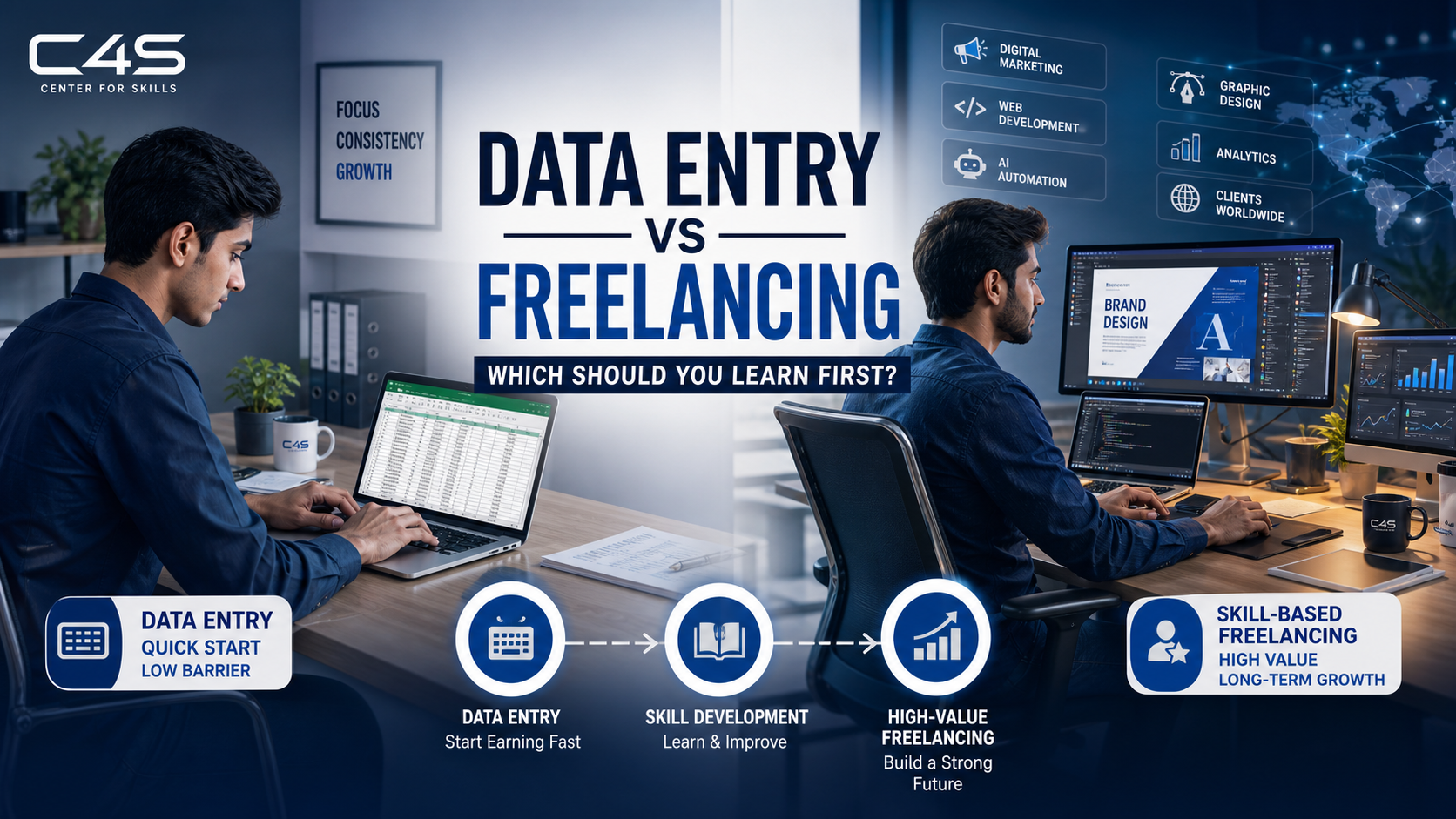
Data entry vs freelancing isn’t really two separate categories fighting for the same spot. Data entry is actually one type of task you can do through freelancing itself, so the comparison people are usually really asking about is data entry work versus higher-skill freelancing, things like digital marketing, design, or web development. A lot of students land on this question after seeing conflicting advice, one person swears data entry is a waste of time, another says it’s how they got started. Both can be true at once, depending on the goal. This guide clarifies that difference honestly, compares income potential and how fast each path gets you earning, and helps you decide which one to focus on first based on your own situation.
Quick Answer, Data Entry vs Freelancing, Which Should You Learn First?
Data entry is the faster, lower-barrier way to start earning online, while broader freelancing skills like digital marketing, design, or web development take longer to learn but pay significantly more over time.
Neither answer is wrong, they just serve different needs. If you need income this month and don’t have time to spend three months learning a new skill, data entry is the realistic starting point. If you can invest a few months upfront, learning something like digital marketing or web development sets you up for a much better income ceiling later. The rest of this guide breaks down exactly why, so you can pick based on your actual situation, not just whichever one sounds more impressive.
It’s worth saying plainly, there’s no shame in either choice. Some of the most successful freelancers in Pakistan started with basic data entry gigs just to get comfortable working with clients online before moving into something more specialized. The path you start on doesn’t have to be the path you stay on.
What Is Data Entry Work, and What Does It Actually Involve?
Data entry work involves inputting, organizing, and cleaning data, usually in Microsoft Excel, Google Sheets, or Microsoft Word, for businesses that need it done accurately and quickly. It’s one of the most common ways people in Pakistan first try earning money online.
This could mean typing information from scanned documents into a spreadsheet, organizing messy customer records, or formatting reports someone else prepared. It’s not glamorous work, but it’s genuinely useful to a lot of small businesses that don’t have time to do it themselves. The core requirements here are fast, accurate typing and real attention to detail, not technical skill or creativity. That’s exactly why it’s such an accessible starting point.
What Does “Freelancing” Actually Mean Beyond Data Entry?
Freelancing is a way of working, selling a skill directly to clients, and it covers everything from data entry to high-value work like digital marketing, graphic design, and web development.
Here’s the part that trips people up. Data entry can technically be freelance work too, if you’re finding clients on your own through a platform. But when most people say “freelancing” as a career path, they usually mean something more specific, building a marketable, in-demand skill and selling it directly to clients, often at a much higher rate than basic data entry pays. That’s the real distinction worth understanding before you decide where to invest your time.
Income Potential, Data Entry vs Skill-Based Freelancing
Data entry work typically has a lower income ceiling since it’s high-competition and low-skill, while skill-based freelancing in areas like digital marketing or web development has a much higher ceiling as skill and experience grow.
The reason for this gap is simple supply and demand. Almost anyone can do basic data entry with minimal training, which means there’s always a large pool of people willing to do it for low rates. Skill-based freelancing requires real, specific expertise that takes months to build properly, which naturally limits the competition and lets skilled freelancers charge more. Neither path guarantees a fixed income, and results vary a lot based on effort and consistency, but the general pattern holds up consistently across the freelancing world.
This doesn’t mean data entry is a dead end though. Plenty of people use it as a stepping stone, building basic client communication skills, learning how freelance platforms actually work, and earning a bit of consistent income while they invest time learning something with more room to grow.
How Fast Can You Start Earning With Each Path?
Data entry lets you start earning almost immediately, since the skill barrier is low, while skill-based freelancing takes weeks or months of learning before you’re ready to pitch clients confidently.
This is the real tradeoff at the heart of this whole comparison. Data entry rewards speed, you can realistically start applying for small gigs within days of deciding to try it. Skill-based freelancing rewards patience, since you genuinely need to build the skill first before you have anything worth selling at a good rate. Neither approach is wrong, it depends entirely on your timeline and how much runway you have before you need income.
Skills You Need for Data Entry Jobs
Data entry mainly requires accurate, fast typing, basic Microsoft Excel and Google Sheets skills, and strong attention to detail.
Beyond typing speed, knowing how to use formulas, sort and filter data, and clean up messy spreadsheets makes you noticeably more useful than someone who just types information in without organizing it properly. Microsoft Word skills matter too, especially for document-based data entry tasks like formatting reports or converting scanned files into clean, editable documents. None of this takes long to learn, which is exactly the point.
Skills You Need for Skill-Based Freelancing
Skill-based freelancing requires an actual specialized skill, like digital marketing, graphic design, or web development, plus the ability to communicate and pitch clients effectively.
This is a genuinely different kind of investment. You’re not just learning a task, you’re building a service you can sell repeatedly, at increasing rates, as you get better at it. Alongside whichever core skill you choose, comfort with tools like ChatGPT and other AI assistants has become increasingly expected across most modern freelance work, since clients now assume freelancers use these tools to work faster and smarter, not as a separate specialty on its own.
Communication matters more here than people expect going in. A freelancer with solid, mid-level skills who explains their work clearly and responds professionally often lands more repeat clients than a technically stronger freelancer who’s difficult to communicate with. This soft skill isn’t something most courses focus on, but it shows up constantly in who actually builds a sustainable freelance career.
Where to Find Data Entry and Freelancing Work
Both data entry and skill-based freelance work are commonly found on the same platforms, the difference is in what you’re offering, not where you look.
Fiverr and Upwork host both types of work side by side, from basic data entry gigs to high-value digital marketing and web development projects. Freelancer is another option worth trying, similar in structure to Upwork. LinkedIn tends to work better for skill-based freelancing specifically, since it’s more suited to direct outreach and building a professional reputation over time than it is for picking up quick data entry tasks.
Can You Do Both, Starting With Data Entry While Learning a Higher Skill?
Yes, and this is actually a common, realistic path, starting with data entry for quick income while learning a higher-value skill on the side.
This works well as a practical bridge strategy, not a permanent plan. Data entry can cover some income while you spend evenings or weekends learning digital marketing, design, or web development properly. The goal is to transition once your higher-value skill is genuinely ready to sell, not to stay on data entry indefinitely once a better-paying option is available to you. A lot of successful freelancers in Pakistan actually started exactly this way.
The main risk with this approach is letting the data entry work become too comfortable to leave. It’s easy to keep taking small, familiar gigs instead of pushing through the harder, slower process of learning a new skill. Setting a rough timeline for yourself, even something loose like “three months to finish this course and start pitching,” helps keep the bridge strategy from turning into a permanent stop.
Which Path Fits You Best?
Choose data entry first if you need income quickly and have little time to learn a new skill right now. Choose skill-based freelancing first if you can invest a few months upfront for a much higher long-term ceiling.
There’s no universal right answer here, it genuinely depends on your situation. A student with more free time and no urgent financial pressure is usually better off investing early in a skill like digital marketing or web development. Someone who needs income immediately, with no cushion to wait a few months, reasonably starts with data entry and plans to transition later once things stabilize.
One more honest factor worth weighing, how much you actually enjoy the type of work matters too. Someone who genuinely likes writing, design, or building websites will stick with the learning curve of skill-based freelancing far more easily than someone forcing themselves through it purely for the income ceiling. Motivation runs out fast when the work itself feels tedious.
How to Start Learning Freelancing Skills in Pakistan
Structured training helps beginners move from data entry level income into skill-based freelancing faster than self-teaching alone, especially when time matters.
Pakistan’s remote work and online earning scene has grown a lot in recent years, and the Ministry of Information Technology and Telecommunication has been actively supporting this shift as part of the country’s broader digital push. If you’re ready to build a real, higher-value skill, C4S offers practical courses in digital marketing, graphic design and video editing, web development, and AI. You can browse the full training list to see what fits your goals, or reach out directly if you have questions before enrolling.
Frequently Asked Questions
Is data entry a good way to start earning online in Pakistan?
Yes, data entry is a genuinely good starting point for earning online quickly, since it requires minimal skill investment, though it typically has a lower income ceiling than skill-based freelancing.
Can I do data entry and freelancing at the same time?
Yes, many people start with data entry for quick income while learning a higher-value freelance skill on the side, then transition once that skill is ready to sell at better rates.
Which pays more, data entry or skill-based freelancing?
Skill-based freelancing, in areas like digital marketing or web development, generally has a much higher income ceiling than data entry, since it involves specialized skill and less competition.
Do I need experience to start data entry work?
No, data entry work is one of the most accessible starting points online, mainly requiring accurate typing, basic Excel or Google Sheets skills, and attention to detail rather than prior experience.
Is freelancing better than data entry for a long-term career?
Yes, for a long-term career, skill-based freelancing tends to offer better growth and income potential than data entry, though data entry can still work well as a short-term starting point.
Which skill should a student learn first after Matric or Inter?
Students with more available time are usually better off investing early in a skill-based freelancing path like digital marketing or web development, since it builds toward a stronger long-term career.
Final Thoughts
Data entry vs freelancing isn’t really a competition between two equal options; it’s a tradeoff between speed and long-term value. Data entry gets you earning fast with minimal skill investment, while skill-based freelancing takes longer to build but pays off far more over time. Plenty of people reasonably do both, starting with one while building toward the other, and there’s nothing wrong with taking that slower, more practical route. If you’re ready to start building a real, skill-based freelance career, reach out to Center 4 Skills (C4S) and figure out where to begin.