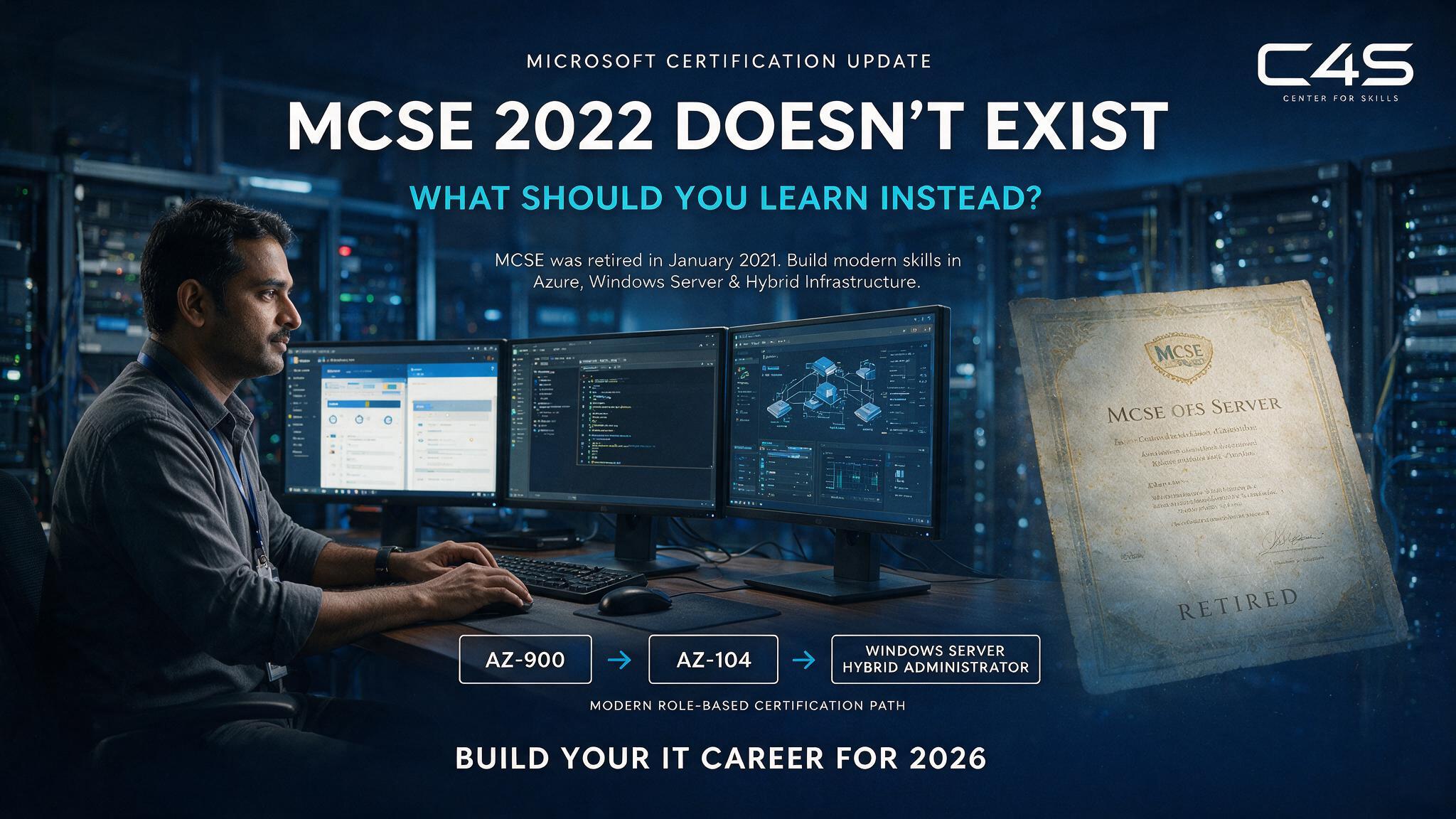
MCSE 2022 doesn’t exist, since Microsoft retired the MCSE certification entirely in January 2021, months before Windows Server 2022 even released. If you’ve been searching for it assuming there’s a newer version tied to the 2022 server release, that assumption is understandable, but it’s based on outdated information floating around online, some of it published years after the certification actually stopped being offered. This guide explains exactly what happened to MCSE, what replaced it, how the modern certification path maps to Windows Server 2022 and Azure, and whether it’s genuinely worth learning in 2026.
Quick Answer, Is There an MCSE 2022, and Is It Still Worth Learning?
There is no MCSE 2022, MCSE was retired by Microsoft in January 2021, but the underlying skills and career path are absolutely still worth learning through Microsoft’s current role-based certifications.
This matters more than a simple trivia correction. If you spent months preparing for an “MCSE 2022” exam, you’d be preparing for something that literally cannot be scheduled or earned, which would waste real time. The good news is the actual skills, Windows Server administration, identity management, hybrid cloud infrastructure, are more relevant than ever, they just live under different certification names now. The rest of this guide explains the real timeline and exactly what the modern equivalent path looks like.
It’s worth being clear about why this confusion keeps happening. Old blog posts, forum threads, and even some outdated training providers still reference MCSE as if it’s active, sometimes attaching a year to it that makes it sound current. That’s exactly the kind of stale information this guide is correcting.
What Happened to MCSE, A Quick Timeline
Microsoft retired MCSE, along with MCSA and MCSD, on January 31, 2021, replacing them with a layered, role-based certification system.
This wasn’t a small, quiet change either, it affected three major certification tracks all at once. Microsoft’s reasoning was fairly clear, they wanted certifications tied directly to specific job roles rather than one broad, multi-product credential that tried to cover too much ground at once. You can confirm this retirement and see current certification offerings directly on Microsoft Learn, which is Microsoft’s own documentation for all of this.
If you already hold an MCSE from before the retirement date, nothing happens to it retroactively, it still appears on your Microsoft transcript and remains a valid part of your professional history. What changed is simply that nobody can earn a new one going forward, since the exams themselves were discontinued.
What Replaced MCSE, Microsoft’s Role-Based Certifications
MCSE was replaced by a tiered system starting with Fundamentals-level exams like Azure Fundamentals (AZ-900), moving to Associate-level certifications like Azure Administrator Associate (AZ-104) and Windows Server Hybrid Administrator Associate, and up to Expert-level credentials for advanced roles.
This system maps more directly to real job titles than the old, broader MCSE ever did. Instead of one certification covering a wide sweep of Microsoft products, you now pick a track that matches the actual work you want to do, and progress through it step by step, from foundational knowledge up to genuine expert-level credentials. It’s a more honest reflection of how specialized IT careers have actually become.
This layered structure also means beginners have a much clearer starting point than they used to. Where MCSE could feel like a large, intimidating target to aim for all at once, the current system lets you build confidence gradually, passing a foundational exam first, then choosing a specific direction once you have a better sense of what actually interests you.
Windows Server 2022 and the Modern Certification Path
Windows Server 2022, released after MCSE’s retirement, is covered through current certifications like the Windows Server Hybrid Administrator Associate credential, which reflects how most real environments now blend on-premises servers with cloud infrastructure.
There isn’t a certification literally named after a specific Windows Server version anymore, and that’s worth understanding clearly. The role-based names describe the job function, hybrid server administration, cloud administration, identity management, rather than tying the credential to one particular software release. This actually makes more sense long-term, since it means the certification stays relevant across version updates rather than needing a brand new name every time Microsoft ships a new server release.
This shift also means the certification ages better. An MCSE tied to a specific server version eventually felt outdated once that version aged out of common use. A role-based certification like Windows Server Hybrid Administrator Associate stays conceptually relevant even as the underlying server version updates, since the actual skills, managing identity, security, and hybrid infrastructure, transfer across versions.
Skills Covered in Modern Microsoft Certifications
Modern Microsoft certifications cover Windows Server administration, identity management, and hybrid cloud infrastructure together, reflecting how real IT environments actually run today, not how they ran a decade ago.
This includes Active Directory and its cloud counterpart Microsoft Entra ID for identity and access management, since most businesses now manage user accounts across both on-premises and cloud systems simultaneously. PowerShell shows up throughout for automation and administration tasks, since manually clicking through repetitive admin work doesn’t scale well. Hyper-V covers virtualization, letting one physical server run multiple virtual machines efficiently. Microsoft 365 and Azure round this out, covering the cloud services side that’s become inseparable from modern IT infrastructure work.
None of these skills exist in complete isolation from each other either. A real IT infrastructure role usually touches several of these at once, managing identity through Active Directory while also handling Azure resources, or automating a repetitive Hyper-V task through a PowerShell script. Learning them as connected pieces, not separate topics, better reflects how the job actually works day to day.
MCSE vs Azure Certification, What’s the Real Difference?
MCSE was built around on-premises server expertise across multiple Microsoft products, while today’s Azure-focused certifications reflect the shift toward hybrid and cloud-first infrastructure that most businesses now run.
This isn’t just a certification rename dressed up as something new, it’s a genuine reflection of how the actual work has changed. A system administrator in 2015 spent most of their time managing physical servers sitting in a server room. A system administrator today, even in a fairly traditional business, is far more likely to be managing some mix of on-premises infrastructure and cloud services, often at the same time. The certification system evolved because the job itself evolved first.
This is worth keeping in mind if you’re deciding how to specialize. Focusing purely on old-style, on-premises-only server skills, without any Azure or hybrid knowledge, increasingly limits your options, since fewer businesses run purely on-premises environments with no cloud component at all anymore.
Is It Still Worth Learning the MCSE-Equivalent Path in 2026?
Yes, the modern equivalent path is genuinely worth learning, since Windows Server administration, Active Directory, and Azure skills remain in strong demand, especially in hybrid environments common across Pakistani businesses.
This isn’t hype, it’s a fairly boring, stable fact about IT infrastructure work. Businesses aren’t abandoning Windows Server environments overnight, and very few are moving 100 percent into the cloud with nothing left on-premises. That hybrid reality is exactly what the modern certification path is built around, which makes it a genuinely practical skill set rather than a trend that might fade in a year or two.
This kind of steady, unglamorous demand is actually a good sign for anyone considering this path. Skills tied to genuine hype cycles can lose value quickly once the excitement fades. Skills tied to how businesses actually keep their systems running day to day tend to stay valuable for a much longer stretch, precisely because they’re less exciting to talk about but more consistently needed.
How to Start the Modern Microsoft Certification Path
The practical starting point is Azure Fundamentals (AZ-900), a beginner-level exam that builds toward more specialized Associate-level certifications like Azure Administrator Associate (AZ-104).
AZ-900 doesn’t require deep technical experience going in, it’s designed as an accessible entry point covering core cloud concepts and how Azure services work at a foundational level. From there, moving into AZ-104 or the Windows Server Hybrid Administrator Associate track builds more specific, job-ready skills. Microsoft Learn offers free, official study material for all of these certifications directly, which is worth using as your primary reference rather than relying solely on third-party guides.
A common, sensible approach is spending a few weeks on AZ-900 fundamentals before deciding which Associate-level track to specialize in next. That short foundational period helps clarify whether you’re more drawn to the cloud administration side or the hybrid server management side, rather than committing to a specific Associate-level exam before you have enough context to make that call confidently.
Microsoft Certification Careers in Pakistan
This certification path connects to real System Administrator and IT infrastructure roles across Pakistani businesses running Windows Server and Microsoft 365 environments.
Almost every mid-sized to large business in Pakistan runs some combination of Windows Server infrastructure and Microsoft 365 for email and collaboration, which keeps steady demand for people who can manage and troubleshoot these systems. Salaries vary based on experience, the specific mix of skills someone brings, and whether a role is purely local or connected to a larger, more complex environment, so it’s more useful to focus on building genuine, hands-on competence than expecting a fixed number tied to the certification alone.
These roles also tend to offer a fairly clear growth path. A junior system administrator managing basic day-to-day tasks can, with experience and additional certifications, move into more senior infrastructure roles overseeing larger hybrid environments, cloud migrations, and identity management for entire organizations.
How to Build Practical IT Skills in Faisalabad
Structured, hands-on training helps build the practical, applied skills that support this certification path, even without a dedicated Microsoft-specific course available locally.
Identity and infrastructure security concepts overlap meaningfully with cybersecurity work, and C4S’s cybersecurity and ethical hacking course touches on related networking and security fundamentals as part of its curriculum. You can browse the full training list to see current offerings, and if you’re specifically interested in Microsoft server or Azure-focused training, reaching out directly is the best way to check what’s currently available.
Frequently Asked Questions
Is there an MCSE 2022 certification?
No, there is no MCSE 2022. Microsoft retired MCSE in January 2021, before Windows Server 2022 even released, so no version tied to that release ever existed.
When was MCSE actually retired?
MCSE was officially retired by Microsoft on January 31, 2021, alongside MCSA and MCSD, replaced by a newer, role-based certification system.
What replaced MCSE?
Microsoft’s role-based certifications replaced MCSE, including Azure Fundamentals, Azure Administrator Associate, and Windows Server Hybrid Administrator Associate, structured in Fundamentals, Associate, and Expert tiers.
Is learning Microsoft server and cloud skills still worth it in 2026?
Yes, Windows Server administration, Active Directory, and Azure skills remain in strong, steady demand, especially since most real businesses run hybrid environments combining on-premises and cloud infrastructure.
What is the first certification I should get on the modern Microsoft path?
Azure Fundamentals (AZ-900) is the typical starting point, since it covers core cloud concepts at a beginner level before moving into more specialized Associate-level certifications.
Can I still use an old MCSE certification on my resume?
Yes, an MCSE earned before its retirement remains valid on your resume and Microsoft transcript, though pairing it with a current certification shows employers your skills are up to date.
Final Thoughts
There is no MCSE 2022, but the modern role-based Microsoft certification path is genuinely worth learning for real IT infrastructure careers, especially in Pakistan’s growing mix of on-premises and cloud environments. Starting with Azure Fundamentals and building toward Associate-level certifications gives you a current, relevant credential that actually matches what employers are hiring for today, rather than a certification name that no longer means anything. If you’re ready to start building practical IT skills, reach out to Center 4 Skills (C4S) and figure out where to begin.