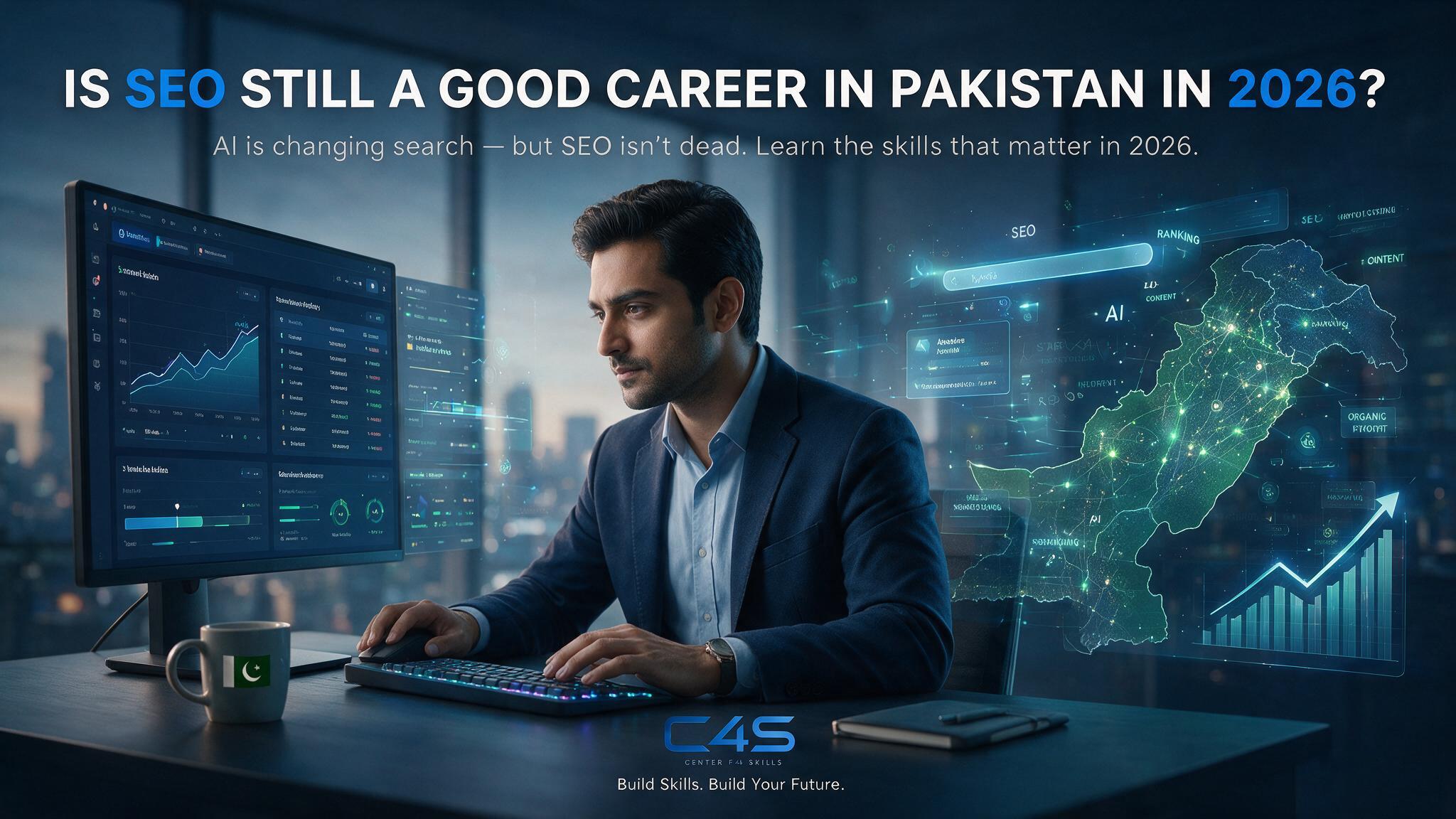
An SEO career in Pakistan is still genuinely good in 2026, but the field has changed enough that anyone learning it now needs to understand what modern SEO actually involves, not just what it meant a few years ago. A lot of advice online is either stuck in the past, treating SEO like it’s 2019, or swinging to the opposite extreme and calling it dead because of AI. Neither is accurate, and both keep circulating because extreme takes get more attention than honest, nuanced ones. This guide covers real salary and demand information, how AI has actually changed the field, what skills matter now, and how to realistically start.
Quick Answer, Is SEO a Good Career in Pakistan in 2026?
Yes, SEO remains a genuinely good, growing career in Pakistan, but the skill set has expanded beyond classic keyword ranking to include AI search visibility, being cited in AI Overviews and AI chat tools, not just traditional blue-link SEO.
This isn’t a small footnote either, it’s the whole picture now. Someone learning SEO purely as “get a page to rank number one on Google” is learning half the job. The other half, making sure your content actually gets cited when ChatGPT, Gemini, or Google’s AI Overview answers a related question, has become just as real and just as valuable. The rest of this guide breaks down demand, salary, AI’s real impact, and how to start.
Understanding this early actually gives you an advantage over people who learned SEO years ago and haven’t updated their approach. A lot of experienced SEO professionals are still catching up to what AI search visibility actually requires, which means someone learning the current version of the skill from scratch isn’t necessarily behind, they might just be starting closer to where the field is actually heading.
Is SEO Dying Because of AI? What the Data Actually Shows
No, SEO is not dying, but AI Overviews have caused real click-through declines on informational search queries specifically, while roughly half of all searches still show no AI Overview at all.
Here’s the honest truth: AI Overviews have reduced clicks to top organic results, with some studies reporting 30% to 58% drops for informational searches. However, about half of Google searches still show no AI Overview, while overall search volume continues to grow. Thin, generic, keyword-stuffed content is declining, while expert, useful, well-structured content remains strong in rankings and AI citations. Learn more from Google Search Central.
It’s worth being specific about which queries actually lose the most here too. Purely informational searches, “what is a mortgage rate,” “how does compound interest work,” lose the most clicks, since users often just want a quick fact. Searches tied to decisions, purchases, or specific local needs still drive real clicks, since AI-generated summaries rarely fully satisfy someone who’s actually ready to buy something or book a service.
What Modern SEO Actually Involves in 2026
Modern SEO combines traditional technical, on-page, and off-page work with a newer layer focused on structured data and content built to be cited accurately by AI systems.
Ranking well in traditional blue-link results still matters, real people still search and click through constantly. But there’s a second, newer goal running alongside it now, being the actual source an AI Overview or a ChatGPT answer references when someone asks a related question. This second goal rewards clear structure, credible sourcing, and genuinely accurate, well-organized content, which happens to overlap heavily with what good traditional SEO always rewarded anyway. The two goals aren’t in conflict, they mostly reinforce each other.
This overlap is actually the reassuring part of this whole shift. Someone who’s genuinely good at traditional SEO, writing clear, well-researched, properly structured content, is already most of the way toward being good at AI search visibility too. The core skill hasn’t changed as dramatically as the headlines suggest, it’s the added layer of understanding how AI systems select and cite sources that’s genuinely new.
SEO Skills in Demand for 2026
Employers and clients now expect a broader skill set covering technical SEO, analytics, and AI-assisted workflows together.
This means comfort with Google Search Console and Google Analytics 4 (GA4) for tracking real performance, Semrush, Ahrefs, or Moz for keyword and competitor research, and Screaming Frog SEO Spider for deeper technical audits. On-page implementation usually happens through WordPress paired with Rank Math or Yoast SEO. Local SEO work increasingly centers on Google Business Profile optimization, especially for businesses serving a specific city or area. Alongside all of this, genuine comfort using ChatGPT for research and content drafting has become part of the normal, expected SEO workflow, not a separate, optional skill.
Learning all of these tools at once can feel overwhelming, so it’s worth prioritizing. Start with Search Console and GA4, since understanding your own data comes before optimizing anything. Then add a research tool like Semrush or Ahrefs, followed by WordPress and an SEO plugin for actual implementation. Everything else layers on from there as you take on real projects.
SEO Job Demand in Pakistan
Demand for SEO skills in Pakistan continues growing as more local and international businesses invest in organic visibility, both through in-house hires and freelance work.
More Pakistani businesses are realizing that showing up in search results, whether that’s traditional Google rankings or AI Overview citations, directly affects how many customers actually find them. This connects to a bigger picture too, Pakistan’s digital economy has been growing steadily, and the Ministry of Information Technology and Telecommunication has been actively supporting that growth for years now. More businesses building an online presence means steady, ongoing demand for people who can actually make that presence findable.
SEO Salary Expectations in Pakistan
Salaries vary widely based on specialization, portfolio strength, and whether work is local or international, so there’s no single reliable figure worth quoting here.
Entry-level SEO roles typically pay less while someone builds real, demonstrated results to point to. As experience grows, particularly with a track record of measurable ranking or traffic improvements, pay tends to increase steadily. Freelancers working with international clients often earn more than those working only with local businesses, since global demand for skilled SEO specialists stays consistently strong. Rather than chasing a specific number early on, it’s more useful to focus on building genuine, provable results, since that’s what actually drives better rates over time.
Freelance SEO vs In-House SEO Jobs
Freelance SEO offers flexibility and often higher rates with international clients, while in-house roles offer stability and deeper, longer-term involvement with one brand’s overall growth strategy.
Freelancing suits people who want control over their schedule and are comfortable managing multiple client relationships at once. In-house roles suit people who prefer working deeply on one brand’s strategy over time, often with more structured mentorship early in a career. Neither path is objectively better, and plenty of SEO professionals move between both over the course of their career, depending on what stage they’re at.
SEO Career Roadmap, From Beginner to Expert
A realistic SEO roadmap starts with on-page fundamentals, moves into technical SEO, builds tool mastery, then branches into a specialization like local SEO, e-commerce SEO, or AI search visibility work.
Start with on-page basics, titles, headings, content structure, and keyword research, since this is the most approachable entry point. Move into technical SEO next, site speed, crawlability, structured data, which requires a bit more comfort working inside a website’s backend. From there, build real fluency with the core tools, Search Console, GA4, and a research tool like Semrush or Ahrefs. The final stage is choosing a direction to specialize in, whether that’s local SEO for service businesses, e-commerce SEO for online stores, or the newer AI search visibility work that’s becoming its own genuine specialty.
Most beginners try to rush through these stages, especially the technical SEO part, since it feels less exciting than writing content. Resisting that urge pays off, since technical issues can quietly undermine even the best-written content if search engines and AI systems struggle to properly access and understand a site in the first place.
Is an SEO Certification Necessary?
A certification helps but isn’t strictly necessary, since clients and employers care more about a real portfolio showing actual ranking or traffic improvements.
A certificate can support a resume and show structured learning, but nobody hires an SEO specialist purely because of a certificate. What actually convinces a client or employer is proof, a case study showing a real site’s traffic or rankings improving because of your work. If you can build that kind of evidence, whether through client work, freelance projects, or your own practice site, that carries far more weight than any certification on its own.
This is actually good news for beginners without any formal background. Building one solid, well-documented case study, even on a small personal or volunteer project, does more for your credibility than collecting several certificates ever will.
How to Start an SEO Career in Faisalabad
Structured, hands-on training builds real SEO skills faster than piecing together scattered, often outdated free tutorials that never quite connect the pieces together properly.
A lot of free SEO content online is genuinely years old and doesn’t reflect how the field actually works in 2026, especially around AI’s impact. C4S offers a dedicated SEO course covering both traditional and current SEO practices, or if you want a broader foundation first, the digital marketing course covers SEO alongside paid ads and content. Reach out directly if you have questions about which path fits your goals.
Frequently Asked Questions
Is SEO still worth learning in 2026?
Yes, SEO remains a genuinely valuable skill in 2026, though it now includes optimizing for AI citation alongside traditional ranking, which makes it a broader, more current skill set than it used to be.
Is SEO dying because of ChatGPT and AI Overviews?
No, SEO is not dying. AI Overviews reduce clicks on some informational queries, but roughly half of searches show no AI Overview at all, and expertise-based content continues to perform well in both traditional and AI-driven search.
What is the average SEO salary in Pakistan?
Salaries vary widely based on specialization, portfolio strength, and whether work is local or international, so it’s more useful to focus on building demonstrated results than expecting a fixed figure.
Can I freelance as an SEO specialist without a degree?
Yes, freelance SEO work depends much more on a proven track record of real ranking or traffic improvements than on holding a formal degree in marketing or a related field.
How long does it take to become job-ready in SEO?
Most beginners can reach a genuinely job-ready, entry level within a few months of consistent, hands-on practice, though real expertise continues developing over years of applied work.
Do I need to learn AI tools alongside traditional SEO?
Yes, comfort with AI tools like ChatGPT for research and content assistance has become part of the standard, expected SEO workflow in 2026, not a separate, optional add-on skill.
What is the scope of an SEO career in Pakistan?
An SEO career in Pakistan offers opportunities in agencies, companies, and freelance work. With practical SEO skills and experience, you can work with both local and international clients.
Final Thoughts
SEO remains a genuinely good career in Pakistan, but success in 2026 requires understanding both traditional SEO and AI search visibility together, not clinging to outdated tactics or writing the field off entirely because of a scary headline. Demand keeps growing as more businesses realize how much their visibility depends on being found, whether through a traditional search result or an AI-generated answer. If you’re ready to start building real SEO skills, reach out to Center 4 Skills (C4S) and take the next step.